SupIR 25-150 mm f/1.4 LWIR Motorized Continuous Zoom SXGA Imaging Lenses
SupIR 25-150 mm f/1.4 LWIR Motorized Continuous Zoom SXGA Imaging Lenses
SXGA LWIR zoom lens for uncooled LWIR thermal imaging systems
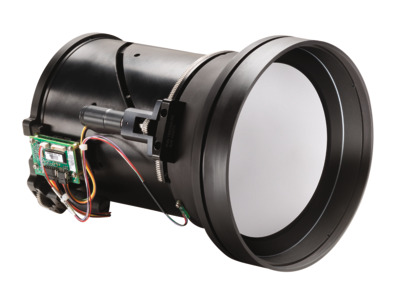
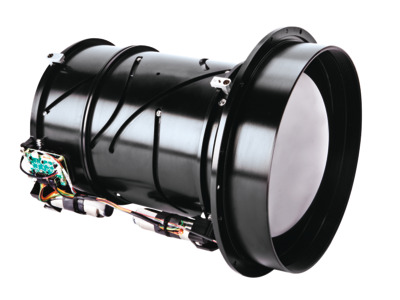
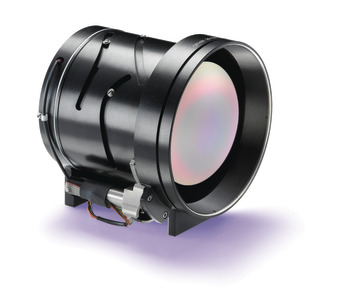
The SupIR 25-150mm f/1.4 motorized focus LWIR imaging zoom lens has a 25 to 150 mm focal length with an f-number of 1.4. This continuous zoom lens is designed for 1280x1024 SXGA format uncooled LWIR cameras.
- Advanced technologies for the highest performance long wave focal planes
- LWIR High-durability and hard-carbon AR coatings for 8-12 µm
- Passive athermalization with the highest imaging performance from -32 to +80°C
- Compatible with 12 & 17 μm pixel pitch, 1280x1024 SXGA format LWIR cameras
- Maintains sharp focus over the entire motorized zoom range
- Vehicle detection range exceeding 8.5 km See All Features
HFOV [deg]
WFOV (25 mm)
| Format | ||||||
|---|---|---|---|---|---|---|
| Pitch | 320x240 | 640x480 | 1024x768 | 1280x1024 | ||
| 17 µm | 12.5° | 25.3° | 41.5° | |||
| 12 µm | 8.8° | 17.7° | 28.7° | 36.3° | ||
NFOV (150 mm)
| Format | ||||||
|---|---|---|---|---|---|---|
| Pitch | 320x240 | 640x480 | 1024x768 | 1280x1024 | ||
| 17 µm | 2.1° | 4.1° | 6.6° | |||
| 12 µm | 1.5° | 2.9° | 4.6° | 5.8° | ||
Specifications
- TypeContinuous Zoom
- Focal Length25-150 mm
- F/#1.4
- Spectral Range8-12 µm
- Back Focal Length≥28mm in air
- HD FormatYes
- Minimum Focus Range1.2m Wide, 45m Narrow
- Nuc (by defocus)Yes
- Focus MechanismMotorized
- Zoom MechanismMotorized
- Operating Temperature Range-32°C to +80°C
- Storage Temperature Range-54°C to +85°C
- SealingIP 67 front element only
- Drive Voltage12 V
- Current Consumption0.3 A average, 0.8 A peak
- Communication InterfaceRS422
- Wavelength RegionLWIR
Features
SupIR 25-150mm f/1.4 Detection, Recognition & Identification (DRI) Range
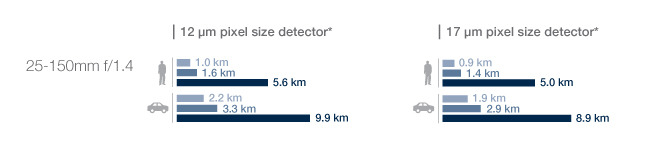
* Assumptions: 50mK NETD (f/1.0) for LWIR uncooled detectors | 30Hz frame rate | 50% detection probability | 0.2km-1 atmospheric attenuation coefficient | human ΔT = 5°C | vehicle ΔT = 2°C
DRI ranges enable one to easily estimate the maximum range that an object can be either detected, recognized or identified. It is important to note that these estimates are based solely on geometrical parameters – the target size, distance, lens focal length and camera detector pixel size. Signal level, detector sensitivity, atmospheric conditions and other factors are not considered!
The calculations used here are based on the “Johnson Criteria”. According to the Johnson Criteria, the minimum resolution, pixels on target, required to achieve a 50% probability for an observer to discriminate an object are:
- Detection: An object is present – 2 pixels on target (Lower Bar)
- Recognition: discern the type of object, a human vs. a vehicle – 8 pixels on target (Middle Bar)
- Identification: discern specific objects, a man vs. a woman, a car model – 12.8 pixels on target (Upper Bar)
Your Long Range Distance Needs Met
High-durability and Hard-carbon AR Coatings
Our highly abrasion-resistant, anti-reflective advanced optical coatings include several types of Hard Carbon coatings which provide maximum durability, energy transmission & minimal reflection. Our innovative coating technologies include:
- Physical Vapor Deposition (PVD) – Thermal heating and electron gun
- Ion Assisted Deposition (IAD) – Ion gun
- Plasma Enhanced Chemical Vapor Deposition (PECVD) for DLC coatings
Passive Athermalized Lens Assembly
Our IR imaging lens assemblies incorporate passive athermalization of the lenses and opto-mechanical system to maintain the highest imaging performance over the full operating temperature range. We use advanced materials that enable unique athermalization properties and optomechanical designs that effectively compensate for optical variations over a wide temperature range.
IR Optics Production Site Virtual Tour
Applications
Commercial
Defense
Resources
Application Notes
Situational Awareness Systems (SAS) Naval Thermal Imaging Maritime Thermal Imaging Security, Surveillance & Homeland Security
Data Sheets
SupIR 25-150 mm f/1.4 Data Sheet(292.6 kB, PDF)
Drawings & CAD
680119 Interface Control Document(257.4 kB, PDF)
Literature
IR Long Range Zoom Lenses Brochure(9.5 MB, PDF)