Broadband 1500 W Water-Cooled Thermopile Sensor with Ø50 mm Aperture
Broadband 1500 W Water-Cooled Thermopile Sensor with Ø50 mm Aperture
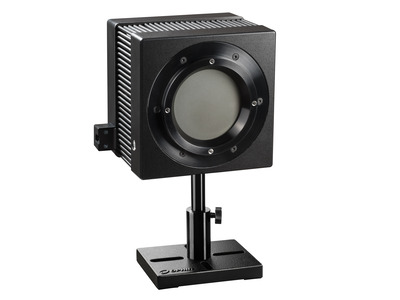
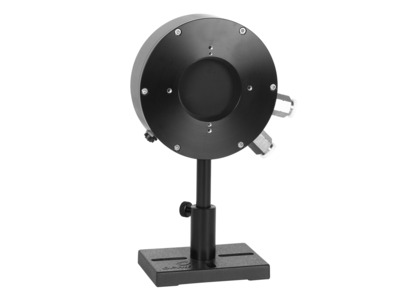
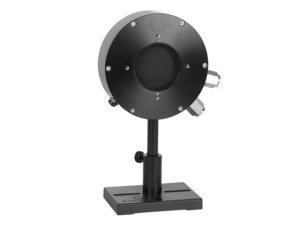
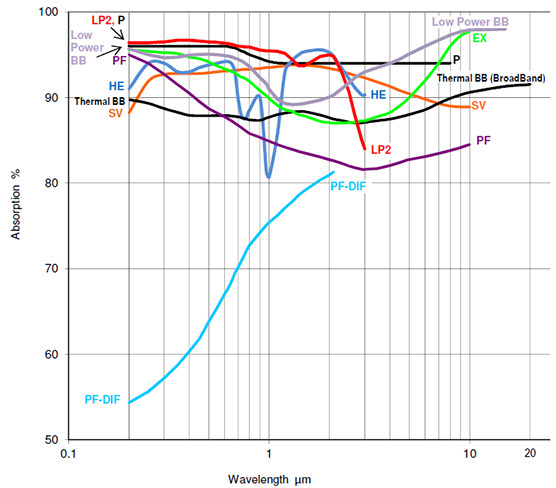
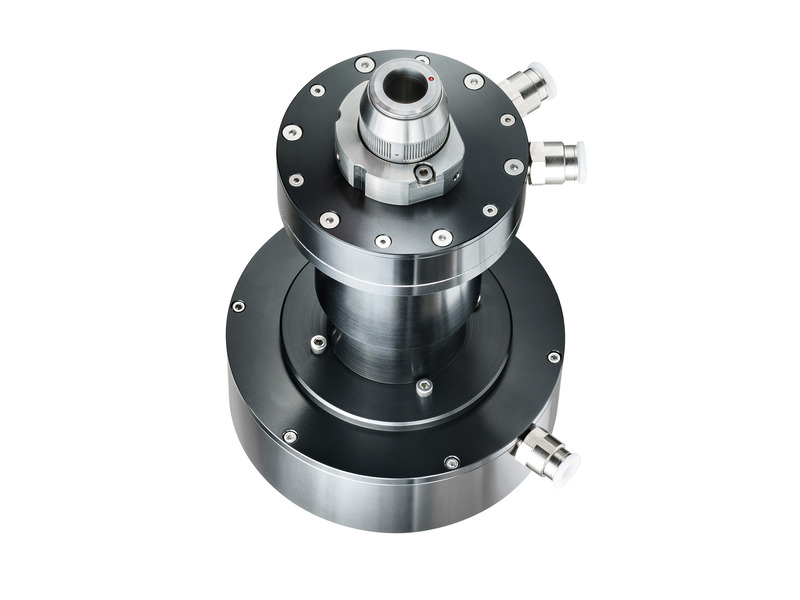
The L1500W-BB-50 thermopile sensor is a water cooled laser power and energy thermal sensor with a 50 mm aperture. It can measure optical power from 15 to 1500 W and energy from 500 mJ to 200 J. It has the spectrally flat broadband BB coating and covers the spectral range from 0.19 to 20 µm.
- Broadband 0.19 to 20 µm absorber
- Water-cooled for 15 to 1500 W average power measurement
- 500 mJ to 200 J energy measurement See All Features
Specifications
- Product NameL1500W-BB-50
- Absorber TypeBB - Broadband general purpose
- Aperture SizeØ50 mm
- Spectral Range0.19-20 µm
- Minimum Power15 W
- Maximum Average Power1500 W
- Minimum Pulse Energy500 mJ
- Maximum Pulse Energy200 J
- Response Time2.7 s
- Maximum Average Power Density4 kW/cm²
- Maximum Energy Density <100 ns0.3 J/cm²
- Maximum Energy Density 2 ms10 J/cm²
- CoolingWater
- DimensionsØ120 x 36 mm
- Cable Length1.5 m
- CE ComplianceYes
- UKCA ComplianceYes
- China RoHS ComplianceYes
Features
Choosing a Thermal Sensor
In this short “Basics” video we review the use – and selection - of thermal sensors for measuring low, medium and high laser powers.
Sensors for Measuring Laser Power
In this short "Basics" video we review in general how one goes about measuring laser beam power, so that you'll have a clear understanding of what the different sensor types are, and when to use each type.
Measuring Ultra High Power Laser Beams
Laser beams with powers of many tens of Kilowatts are becoming more and more common in today's applications, industrial as well as research. This video will discuss the technical challenges in measuring such lasers, and will show you a range of solutions now available from Ophir for measuring up to 100KW -- safely, and accurately.
Water Cooled Sensors: Things to Look Out For
Water cooled sensors are commonly used when measuring laser beams of more than a few hundred watts. In this video, you will learn about some critical issues you need to consider when using water cooling, such as water temperature, water flow rate, and corrosion prevention.
Thermal Power Sensor Accuracy
Ophir former CTO Dr. Ephraim Greenfield discusses the various factors that contribute to uncertainties in measurement when using Ophir laser power and energy meters.
Effects of Incidence Angle on Measurements
In this video, you will learn to what degree a beam’s incidence angle matters, and for which sensor types this should be taken into account.
Thermal Sensor Calibration
As the spectral sensitivity of the absorber used for the power and energy measurement is not fully linear, Ophir sensors get a high precision calibration by default with more than one wavelength.
Each thermal sensor is calibrated independently of a particular Ophir power meter with its calibration information contained in the DB15 plug. When the sensor is connected to the meter, the meter reads and interprets this information to display a calibrated reading. Each power meter is calibrated independently and has the same sensitivity as an other meter within about 2 tenths of a percent.
Unless otherwise indicated, Ophir sensors and meters should be recalibrated within 18 months after initial purchase, and then once a year after that.
Frequently Asked Questions
- How should I clean my sensor?Answer
First, clean the absorber surface with a tissue, using Umicore #2 Substrate Cleaner, acetone or methanol. Then dry the surface with another tissue. Please note that a few absorbers (Pyro-BB, 10K-W, 15K-W, 16K-W and 30K-W) cannot be cleaned with this method. Instead, simply blow off the dust with clean air or nitrogen. Don't touch these absorbers. Also, HE sensors (such as the 30(150)A-HE-17) should not be cleaned with acetone.
Note: These suggestions are made without guarantee. The cleaning process may result in scratching or staining of the surface in some cases and may also change the calibration. - Must I use a particular sensor only with the meter it was ordered with?Answer
Ophir meters and sensors are calibrated independently. Each meter has the same sensitivity as the other within about 2 tenths of a percent. Each sensor is calibrated independently of a particular meter with its calibration information contained in the DB15 plug. When the sensor is connected to the meter, the meter reads and interprets this information. Since the accuracy of our sensors is typically +/-3%, the extra 0.2% error that could come from plugging into a different meter is negligible and therefore it does not matter which calibrated meter we use with a particular calibrated sensor.
- How do you calculate the power and energy density of a laser beam?Answer
If the power is P and the diameter of the beam is D then the power density is P /(.785 * D2) . If it is a pulsed laser and the energy is E, the repetition rate is R and the diameter is D then the power density is E*R/(.785 * D2), The energy density is E/(.785 * D2). The sensor finder will automatically calculate the power and energy density.
- Is there a coolant pressure specification for Ophir water-cooled sensors?Answer
Yes. Please reference the chart below:
Minimum Flow Rates for Water-Cooled SensorsSensor Recommended flow rate at full power1 Minimum flow rate at full power1 Absolute minimum flow rate pressure drop across sensor (at maximum flow rate) pressure drop across 8 meter of tubing (at maximum flow rate) liters/min) (liters/min) (liters/min) Bar MPa Bar MPa L250W 3 3 3 0.3 0.03 L300W 3 3 3 0.3 0.03 1000W 6 3 3 0.3 0.03 0.5 0.05 L1500W 6 3.5 3 0.3 0.03 0.5 0.05 L2000W 6 3.5 3 0.6 0.06 0.5 0.05 5000W 8 5 3 0.6 0.06 0.5 0.05 6K-W-200x200 6 6 5 0.5 0.05 0.3 0.03 10K-W 8 8 3 1 0.1 0.5 0.05 15K-W 12 12 3 2 0.2 1 0.1 16K-W 12 12 3 1 0.1 0.8 0.08 30K-W 25 25 6 2 0.2 3 0.3 120K-W 60 60 30 4 0.4 3.5 0.035 You can find a lot more information about the correct use of water-cooled sensors in the article "How to use water cooled Ophir sensors", here.
- Do I need to recalibrate my instrument? How often must it be recalibrated?Answer
Unless otherwise indicated, Ophir sensors and meters should be recalibrated within 18 months after initial purchase, and then once a year after that.
- What is the best water to use in the Water Cooled Sensors?Answer
Corrosion is caused by interactions between the metallic components of the sensor and the cooling water, which may contain a variety of dissolved ions. Many factors affect the risk of corrosion forming, but the most important are the pH and the mixture of ions in the water. For this reason, we recommend using neutral deionized water in a closed circulating system (pH between 6 and 8). Please note that deionized water is usually slightly acidic (pH 5.65) due to absorption of CO2 from the atmosphere. The cooling water can be neutralized by adding 5 ml of a 10 mM solution of NaOH for each liter of water in the cooling system. Commercial additives such as Optishield Plus are also recommended for systems such as ours that have copper and aluminum in them. Optishield has the additional benefit of having biocide to prevent buildup of organic contamination.
To prevent corrosion it is also crucial to not allow standing water to evaporate inside the sensor when it is not in use. When disconnecting a sensor from the cooling system, the water channel should be cleared by blowing compressed air through it.
For those customers still experiencing problems with corrosion, we recommend the new thermal sensor 1000WP-BB-34 which has a special design in which all materials that come into contact with the cooling water are either copper or nonmetallic.
You can find a lot more information about the correct use of water-cooled sensors in the article "How to use water cooled Ophir sensors", here.
- When an accuracy spec is given, what exactly is meant?Answer
The Ophir specification on accuracy is in general 2 sigma standard deviation. This means, for instance, that if we list the accuracy as +/-3%, this means that 95% of the sensors will be within this accuracy and 99% will be within +/-4%. For further information on accuracy see calibration procedure tutorial.
- The sensor I need uses water cooling. Can you recommend a water cooling system?Answer
We don’t supply chillers, nor insist on specific models; the only important thing from our point of view is to simply keep to the requirements specified for the cooling water of the specific model of sensor, such as minimum flow rate at full power, water temperature range, and - more important than the actual water temperature - water temperature stability. The temperature of the water should not be changing by more than 1 deg/min (because changes in water temperature could cause heat flow in the sensor which would be detected as if it were laser power, and cause errors in the reading).
Our blog has a video on this subject: Water Cooled Sensors: Things to Look Out For, which discusses various issues and tips about water cooling.
- Can a laser measurement depend on the distance from the laser to the sensor?Answer
In theory, if a beam is completely parallel and fits within the aperture of a sensor, then it should make no difference at all what the distance is. It will be the same number of photons (ignoring absorption by the air, which is negligible except in the UV below 250nm). If, nevertheless, you do see such a distance dependence, there could be one of the following effects happening:
- If you are using a thermal type power sensor, you might actually be measuring heat from the laser itself. When very close to the laser, the thermal sensor might be “feeling” the laser’s own heat. That would not, however, continue to have an effect at more than a few cm distance unless the light source is weak and the heat source is strong.
- Beam geometry – The beam may not be parallel and may be diverging. Often, the lower intensity wings of the beam have greater divergence rate than the main portion of the beam. These may be missing the sensor's aperture as the distance increases. To check that you'd need to use a profiler, or perhaps a BeamTrack PPS (Power/Position/Size) sensor.
- If you are measuring pulse energies with a diffuser-based pyroelectric sensor: Some users find that when they start with the sensor right up close to the laser and move it away, the readings drop sharply (typically by some 6%) over the first few cm. This is likely caused by multiple reflections between the diffuser and the laser device, which at the closest distance might be causing an incorrectly high reading. You should back off from the source by at least some 5cm, more if the beam is not too divergent.
Needless to say, it’s also important to be sure to have a steady setup. A sensor held by hand could easily be moved around involuntarily, which could cause partial or complete missing of the sensor’s aperture at increasing distance, particularly for an invisible beam.
- Does the damage threshold depend on power level?Answer
The damage threshold of thermal sensors does depend on the power level and not only the power density because the sensor disc itself gets hotter at high powers. For instance, the damage threshold of the Ophir broadband coating may be 50KW/cm2 at 10 Watts but only 10KW/cm2 at 300W. The Ophir specifications for damage threshold are always given for the highest power of use of a particular sensor, something which is not done by most other manufacturers. This should be taken into account when comparing specifications. The Sensor Finder takes the power level into consideration when calculating damage threshold.
- Once and for all: Is DI (deionized) water good or bad for water-cooled sensors? Does it help prevent corrosion, or does it actually increase the risk?Answer
Many factors affect the risk of corrosion forming, but the two most important are:
- the mixture of ions in the water
- the water’s pH
Our current recommendation is to use DI water – but of a neutral pH. DI water is usually slightly acidic; it can be titrated to a neutral pH, using a bit of sodium hydroxide for example. There are also commercial additives that can help prevent corrosion, for instance Optishield Plus. For a more detailed discussion, see the FAQ at https://www.ophiropt.com/laser--measurement/knowledge-center/faq/7805
You can find a lot more information about the correct use of water-cooled sensors in the article "How to use water cooled Ophir sensors", here.
Accessories
10K-W Protective Cover for Water Cooled Sensors
Protective Cover with Target Pattern for 1000W, L1500W, 5000W, 10K-W and 15K-W sensors (1 unit supplied with 5000W, 10K-W, and 15K-W).
| Compare | Description | Drawings, CAD & Specs | Avail. | Price | ||
|---|---|---|---|---|---|---|
 | 1G01332Protective Cover, 15K-W, 10K-W, 5000W, L1500W, 1000W Sensors |
Metric Water Fitting
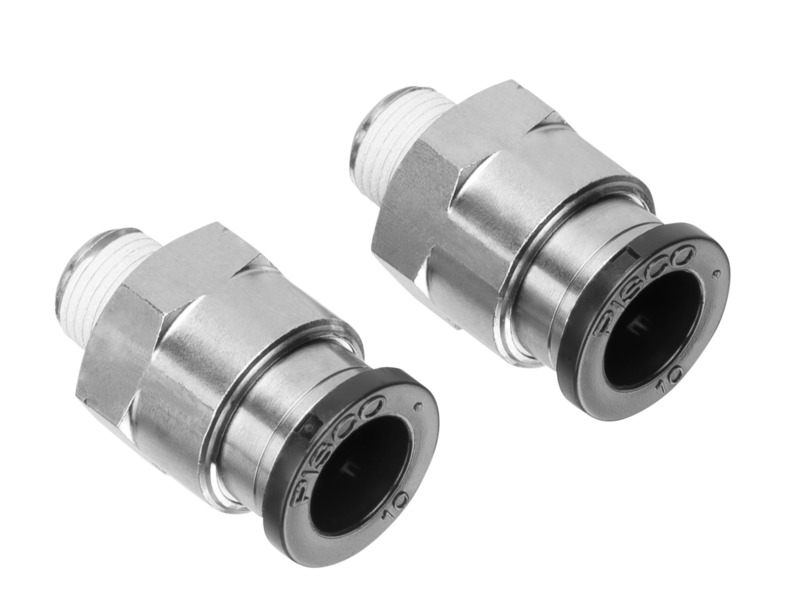
Metric water fittings for all water cooled sensors except 16K-W & 30K-W with quick connection to 10mm plastic tubing. The Metric water fittings are also suitable for the QBH Adapters. Replaces standard fitting connecting to 3/8" tubing (set of 2 each).
| Compare | Description | Drawings, CAD & Specs | Avail. | Price | ||
|---|---|---|---|---|---|---|
 | 7Z08353Metric Water Connector, 10 mm, Water Cooled Sensors |
Fiber Adapters
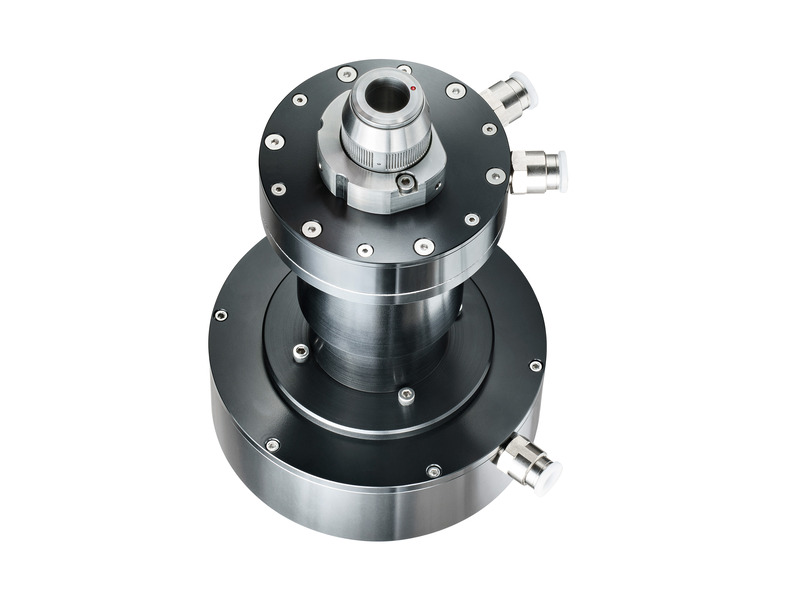
This fiber adapter is used for mounting fibers with QBH termination to high power sensors L1500W-BB-50, L1500W-LP2-50, 5000W-BB-50 and 5000W-LP2-50. Suitable for beams with small or large divergence angles.
Thermal Sensor Cables
Order a cable of a different length along with the sensor to receive a cable other than the standard 1.5 m length.

Sensor Connector to BNC Adapter
The SH to BNC Adapter allows the connection of an Ophir sensor to a current or voltage measuring device for measurement of the raw sensor analog output. A current meter should be used for photodiode sensors. Current or voltage meters can be used for thermal sensors.

Extended Warranty for Sensor
Customers that purchase the above items also consider the following items. Ophir-Spiricon meters and sensors include a standard manufacturers warranty for one year. Add a one year Extended Warranty to your meter or sensor, which includes one recalibration.
| Compare | Description | Drawings, CAD & Specs | Avail. | Price | ||
|---|---|---|---|---|---|---|
 | XWAR-SENSORExtended Warranty for Sensor |
Resources
Data Sheets
Catalogs
Power Sensors Catalog(11.2 MB, PDF) Laser Power & Energy Measurement and Laser Beam Analysis Catalog(27.5 MB, PDF)
Drawings & CAD
L1500W-BB-50 Drawing(265 kB, PDF)
Technical Notes
Absorption, Angle Dependence and Damage Graphs for Thermal Sensors(216.1 kB, PDF) How to Use Water Cooled Ophir Sensors Calibration Method and Estimated Accuracy for Ophir High Power Sensors Calibration Accuracy of Ophir’s High Power Sensors 5 Situations Where Laser Performance Measurement is Necessary Effect of Ambient Conditions on Laser Measurements How do I know what range, or scale, to set my power/energy meter to? How Much of the Power Sensor Aperture Can My Laser Fill Up? How to Properly Select a Laser Power or Energy Sensor Common Reasons for Thermal Sensor Damage or Out of Tolerance Conditions