CO2 Laser Cavity Silicon Polarize Lock Mirrors
CO2 Laser Cavity Silicon Polarize Lock Mirrors
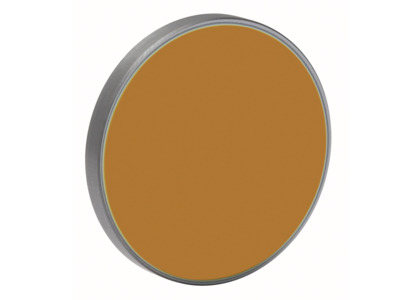
These silicon polarize lock total reflectors are quite similar to turning mirrors. However, durability of the coating is more critical because the total reflectors are exposed to the gas discharge and the extremely high laser power density inside the cavity. Therefore, the coating must have best-possible environmental resistance and low absorption in order to minimize thermal distortion.
- Achieves a truly stable “locked” polarization
- Light-weight Silicon (Si) substrate
- Durable coating for best-possible environmental resistance See All Features
| Compare | Description | Drawings, CAD & Specs | Avail. | Price | ||
|---|---|---|---|---|---|---|
 | 631294-117CO2 Laser Polarize Lock Mirror, Silicon, 1.5 in. Diameter, 9.52 mm Edge, Plano, PLM HR | |||||
| 631555-117CO2 Laser Polarize Lock Mirror, Silicon, 50 mm Diameter, 9.0 mm Edge, Plano, PLM |
Specifications
- TypePolarize Lock Mirror
- Optic MaterialSilicon (Si)
- Angle of Incidence45°
- Surface Quality10-5 scratch-dig
- Surface Irregularity1 Fringe @ 633 nm
- Power2 Fringes @ 633 nm
- Wedge<3' (arc minutes)
- Diameter Tolerance+0/-0.12 mm
- Thickness Tolerance±0.1 mm
Features
Polarize Lock Mirrors
Laser resonators rely on small differences in the reflectivity of fold mirrors for different polarization states to give a stable linearly polarized output. In some cases, the small reflection gaps of the total reflector mirror coatings are not enough to keep the polarization from fluctuating. Using specific properties of the materials selected in optical coating design, we are able to increase the differences in the reflection of S-polarization compared to P-polarization and achieve a truly stable “locked” polarization.
Polarize Lock Mirror Coatings
The PLM-HR mirror coating provides optimized S-Pol reflection (>99.90% for S-Pol), with low enough P-Pol reflection (<93% P-Pol) to enable effective phase locking while still reflecting maximum reflection at the desired S Polarization. It is internal cavity radiation resistant, suitable for both Cu and Si mirrors and can be used in a variety of different resonator type.
| Coating | Substrate | %S-Pol@45°@10.6 | %P-Pol@45°@10.6 | %R@45°@0.6328 |
|---|---|---|---|---|
| PLM | Si | 99.5% | ≤90% | - |
| PLM-W | Cu | 99.8% | ≤90% | - |
| PLM-HR | Cu | >99.9% | ≤97% | ≥65%@630-670nm |
| PLM-HR | Si | >99.9% | ≤93% | ≥65%@630-670nm |
Resources
Videos
Catalogs
Laser Optics Catalog(487.6 kB, PDF) OEM Laser Optical Components Manufacturing Brochure(5.8 MB, PDF)
MSDS
Silicon Mirror Material Safety Data Sheet(33.9 kB, PDF)